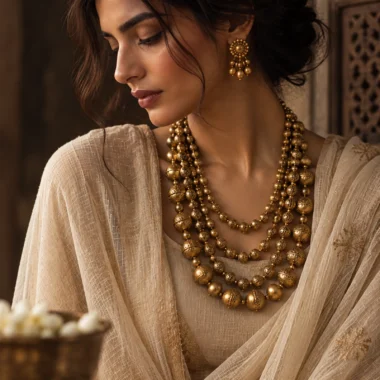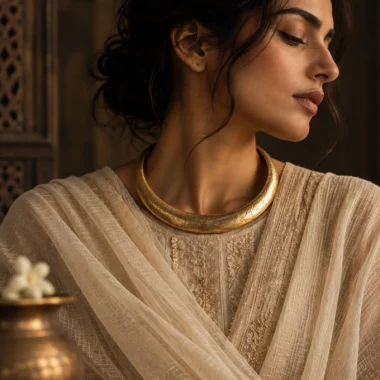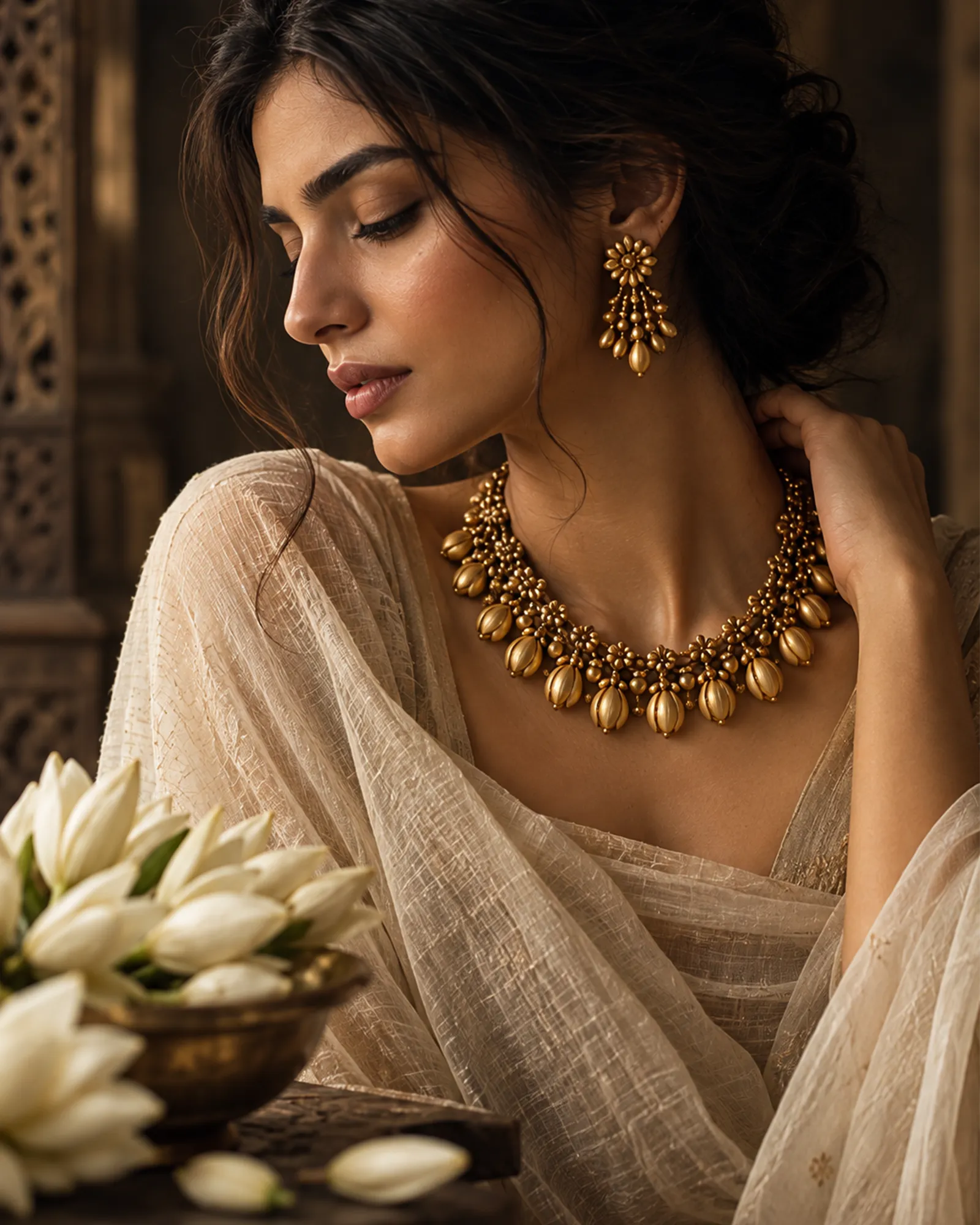
A flower remembered in metal, carried through generations.
Some jewelry begins with precious material. Other jewelry begins with a form remembered across generations.
Champakali jewelry belongs to the latter. Recognized by its rhythmic arrangement of flower- and bud-like elements, the necklace carries the softness of nature into ornament, creating a composition that feels both decorative and deeply familiar.
A FORM INSPIRED BY NATURE
The name Champakali evokes the champa flower and its unopened buds, a natural form translated into jewelry through repeated, delicately suspended elements.
Arranged around the neckline, these forms create a garland-like rhythm. Each element contributes to the whole, allowing the necklace to move between structure and softness, ornament and grace.
It is this repetition that gives the Champakali much of its character. No single element needs to dominate. Instead, the beauty emerges through the relationship between many forms, brought together as one composition.
FROM TRADITION TO MEMORY
The Champakali form appears within the rich jewelry traditions of the region, where floral motifs have long provided inspiration for ornament.
Over generations, such forms become more than decorative objects. They become part of visual memory, recognized in family jewelry, ceremonial dressing and the pieces passed from one generation to another.
That familiarity is part of what gives traditional jewelry its emotional weight. A silhouette, a detail or the movement of a necklace can recall something seen before; perhaps in an old photograph, at a wedding, or among the possessions of an earlier generation.
REIMAGINING THE CHAMPAKALI
At Dervesh Luxe, heritage is not treated as something fixed in the past. We look instead at the forms that have endured and ask how they might live differently today.
In reimagining the Champakali jewelry, the essential rhythm remains: the repetition, the floral character and the sense of a garland around the neckline.
What changes is the expression.
Proportion, detailing, material and the relationship between individual elements can all influence how a traditional form feels when worn today. The intention is not to erase its identity, but to allow that identity to speak within a contemporary wardrobe.
The past provides the vocabulary. The present changes the conversation.
THE GARLAND, MADE MODERN
The Champakali has a natural sense of occasion, but heritage jewelry need not remain confined to ceremonial dressing.
Worn with traditional clothing, its form feels connected to memory and celebration. Paired with a quieter contemporary silhouette, the same necklace can take on a different presence; its repetition, texture and sculptural qualities becoming more pronounced.
This movement between past and present is central to the Dervesh Luxe approach.
We believe traditional forms remain meaningful when they are allowed to evolve with the women who wear them. Not preserved at a distance, but brought into contemporary life with sensitivity and intention.
This is where heritage continues to live, not simply by being remembered, but by being worn again.
A flower from memory. A form for today.